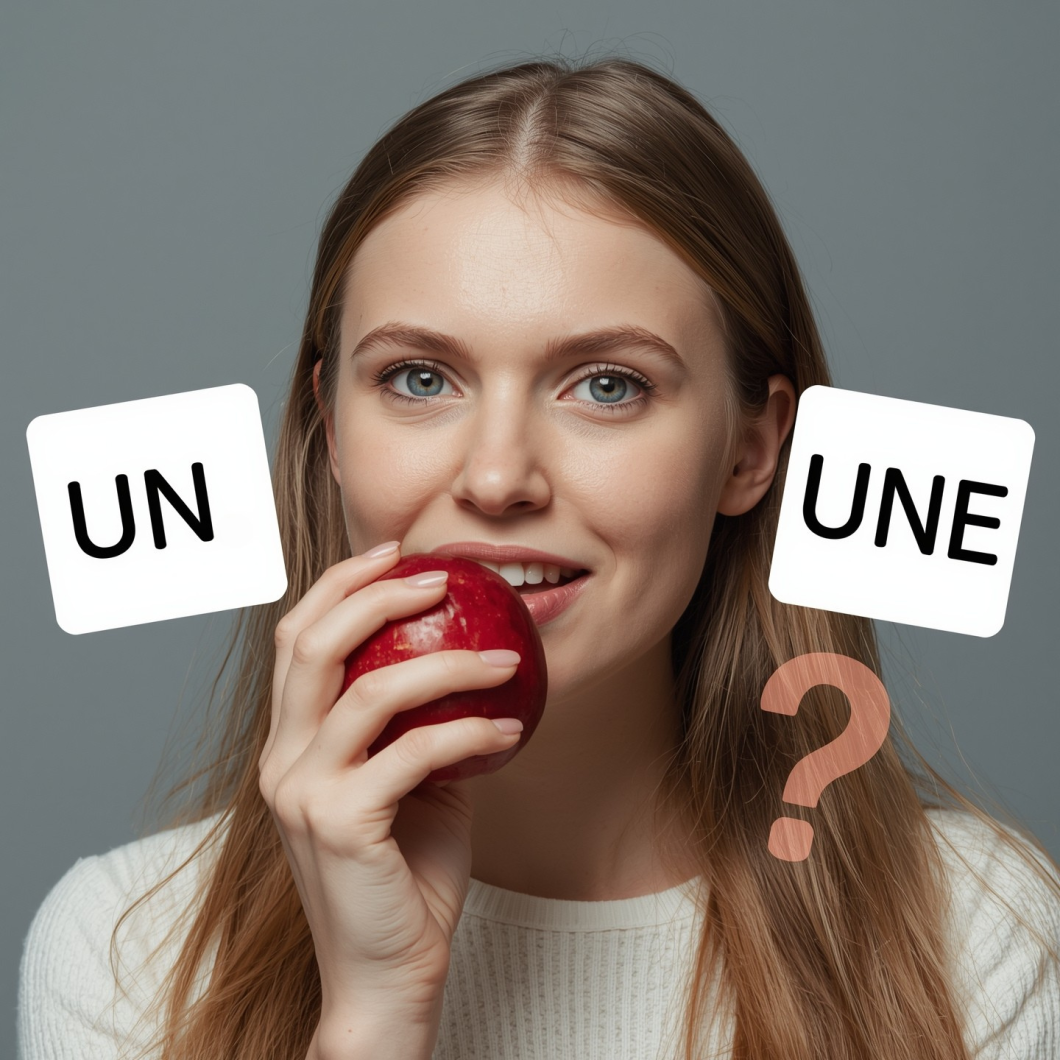
If you’ve just started to learn French, chances are you’ve already stumbled over the little words un and une. They seem simple enough: both mean “a” or “an” in English. But in French, these articles carry an important role—they show whether a noun is masculine or feminine ⚖️.
This brings us to a common question: Why do French words have gender at all? 🤔 The truth is, grammatical gender in French doesn’t mean that objects are literally male or female. An apple (une pomme 🍎) is not biologically female, and a book (un livre 📖) isn’t male. Gender in French is a grammatical category—a way the language organizes and classifies nouns. The challenge for English speakers is that there is no equivalent in English, which makes this one of the most common French learning mistakes.
The good news? 🌟 With the right strategies, you can avoid these mistakes and make French grammar easier to handle. In this article, we’ll cover the top tips to master “un” and “une” so you can build confidence and avoid the mistakes English speakers make in French.
Why Are Un and Une Tricky for English Speakers? 😅
In English, we simply say a book 📖 or an apple 🍎. The word “a” doesn’t change depending on whether the noun is masculine or feminine—because nouns in English don’t have gender.
In French, however:
- un livre = a book (masculine) 📘
- une pomme = an apple (feminine) 🍏
Mixing them up may not stop people from understanding you, but it’s one of those little grammar mistakes that makes your French sound less natural.
Here are some of the most common nouns beginners use, divided into masculine and feminine:
Masculine (un):
- un livre (a book) 📖
- un stylo (a pen) 🖊️
- un ordinateur (a computer) 💻
- un téléphone (a phone) 📱
- un sac (a bag) 🎒
- un chien (a dog) 🐶
- un chat (a cat – masculine form) 🐱
- un café (a coffee) ☕
- un problème (a problem) ❗
- un ami (a friend – masculine) 👦
Feminine (une):
- une pomme (an apple) 🍎
- une voiture (a car) 🚗
- une maison (a house) 🏠
- une table (a table) 🍽️
- une chaise (a chair) 🪑
- une fleur (a flower) 🌸
- une amie (a friend – feminine) 👧
- une école (a school) 🏫
- une question (a question) ❓
- une idée (an idea) 💡
Learning these high-frequency words with their article helps you avoid many early mistakes ✅.
TOP Tips to Master Un and Une 💡
1. Always Learn Nouns with Their Article 📝
Instead of memorizing just the word, learn nouns together with their article. For example:
- Don’t just learn pomme, learn une pomme 🍎.
- Don’t just learn stylo, learn un stylo 🖊️.
👉 Tip: Make flashcards 🎴 where the noun always appears with its article.
2. Watch for Word Endings 🔎
Many French words give you a clue about whether they’re masculine or feminine based on their ending. This isn’t a perfect rule, but it helps reduce common French learning mistakes.
- Usually feminine (-e endings): une table, une voiture, une chaise.
- Usually masculine: words ending in consonants or other vowels like -age, -ment, -oir. For example: un fromage 🧀, un appartement 🏢, un miroir 🪞.
⚠️ But beware: there are exceptions (e.g., un problème ❗).
3. Use Mnemonics to Remember Gender 🎨
Creating a silly image in your head can make remembering easier:
- Picture a girl eating an apple (une pomme 🍎) → apple = feminine.
- Imagine a man reading a book (un livre 📖) → book = masculine.
Personal associations stick better than abstract rules 🧠.
4. Group Vocabulary by Gender 📂
Instead of random word lists, group words into two categories:
- Masculine nouns with un 🟦
- Feminine nouns with une 🩷
For example:
- Un ballon ⚽, un manteau 🧥, un avion ✈️.
- Une robe 👗, une clé 🔑, une bouteille 🍼.
This helps your brain form patterns instead of memorizing isolated words.
5. Label Objects Around You 🏷️
A very effective way to remember gender is to label objects in your home or office with sticky notes including the article. For example:
- Write une table 🍽️ and stick it on your table.
- Write un miroir 🪞 and place it on your mirror.
Seeing the article daily reinforces gender naturally without rote memorization 🪄.
6. Listen and Repeat 🎧
Listening to native French is key to avoiding mistakes English speakers make in French. Notice how un and une sound. They’re not pronounced exactly like in English:
- un → nasal sound, kind of like “uh(n).”
- une → clearer “oon.”
Practice repeating out loud 🗣️ to get used to the rhythm.
👉 Try watching French videos 🎥 with subtitles and shadowing (repeating immediately after the speaker).
7. Don’t Worry About Exceptions (at First) 🌱
Yes, there are exceptions, but obsessing over them too early can slow you down. Focus on building habits: learn the article with the word, notice patterns, and practice regularly. As you progress, you’ll naturally absorb the exceptions 🧩.
Common Mistakes English Speakers Make in French 🚫
Here are the most frequent errors when using un and une:
- Forgetting the article altogether (j’ai crayon instead of j’ai un crayon ✏️).
- Mixing gender randomly (un orange instead of une orange 🍊).
- Not practicing pronunciation, making un and une sound the same 👂.
Understanding these pitfalls is the first step to overcoming them ✅.
How to Avoid French Language Mistakes with Un and Une 🌟
- Create habits early → Always say/write the article with the noun 📝.
- Visualize gender → Use color-coding on flash-cards (blue 🔵 for masculine, pink 🌸 for feminine).
- Expose yourself to French daily → Podcasts 🎧, songs 🎶, or even labeling objects in your home 🏠.
- Correct yourself gently → Mistakes are part of learning 🌱, but try to notice and adjust.
Remember: the goal is not perfection, but progress 🚀.
Articles un and une may seem small, but they play a big role in avoiding common French learning mistakes. By learning nouns with their articles, noticing patterns, and practicing daily, you’ll quickly build confidence and reduce the mistakes English speakers make in French 💪.
👉 Want more practical tips to learn French grammar easily? Check out French grammar explained 📘 and don’t forget to subscribe to our newsletter 📨 for free resources and updates.
FAQ ❓
What is the difference between ‘un’ and ‘une’ in French?
Un is used with masculine nouns, while une is used with feminine nouns. Both mean “a” or “an” in English.
How can I know if a French noun is masculine or feminine?
There are patterns: nouns ending in -e are often feminine 🌸, and nouns ending in -age, -ment, or -oir are usually masculine 🔵. But the best way is to learn each noun with its article.
Why do English speakers struggle with ‘un’ and ‘une’?
Because English doesn’t have gendered nouns, English speakers often forget to include the article or confuse masculine and feminine forms 🙃.
How can I avoid French language mistakes with articles?
Always learn the noun with its article 📝, practice regularly, expose yourself to French in context 🎶, and test yourself with varied examples.