Let’s be honest: few things make French learners sweat more than deciding between passé composé and imparfait. You start telling a story, you hesitate… and boom, the flow is gone.
But here’s the truth: mastering these two past tenses isn’t about memorizing endless French grammar rules. It’s about how you picture the action—is it a finished event, or part of the background?
In this guide, I’ll share 5 clear and practical tips that will help you avoid common French grammar errors, feel more confident, and finally make sense of these tricky past tenses. Ready? Let’s dive in 🚀
👉 Don’t miss our related post: French grammar explained
1. Think of the Action: Completed ✅ vs Ongoing 🔄
-
Use passé composé when the action is finished, concrete, and measurable.
-
J’ai rencontré Paul hier. → I met Paul yesterday (a one-time event).
-
Elle a perdu ses clés. → She lost her keys (done, result matters).
-
-
Use imparfait when the action is unfolding, ongoing, or without a clear end.
-
Je parlais avec mon voisin quand il est arrivé. → I was talking with my neighbor when he arrived.
-
Elle perdait toujours ses clés à l’époque. → She was always losing her keys back then.
-
💡 Quick trick: If you can easily answer “What happened?” → it’s likely passé composé. If you’re describing “What was going on?” → it’s imparfait.
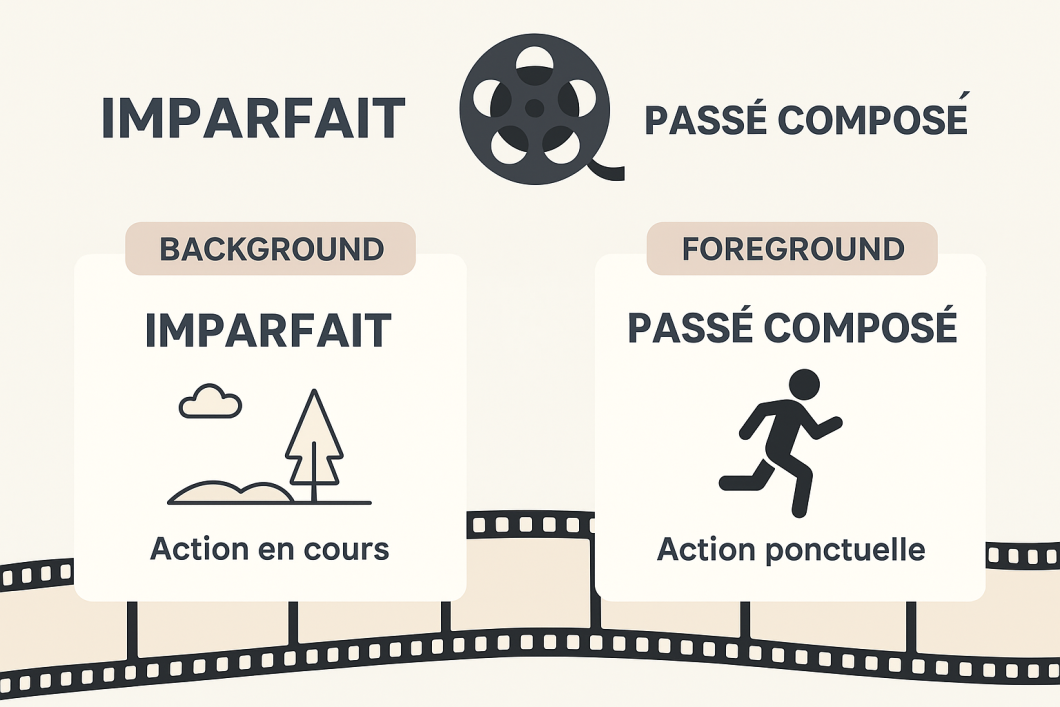
2. Use the “Background 🎬 vs Event 🎯” Trick
Picture a movie scene:
-
Imparfait = background → weather, time, age, feelings, descriptions.
-
Passé composé = events → what moves the story forward.
Example:
Il faisait chaud et tout le monde dansait. Soudain, la lumière s’est éteinte.
→ It was hot and everyone was dancing. Suddenly, the light went out.
✨ Expressions that often signal imparfait:
-
Il était une fois… (Once upon a time…)
-
C’était l’été… (It was summer…)
-
Il faisait beau… (The weather was nice…)
⚡ Expressions that often signal passé composé:
-
Tout à coup… (All of a sudden…)
-
Enfin… (Finally…)
-
À ce moment-là… (At that moment…)
👉 The secret? Mix them together to create rich storytelling.
3. Habitual 🔁 vs One-Time ⏳ Actions
This is one of the easiest distinctions once you’ve spotted it:
-
Imparfait = habit, repetition, “used to.”
-
Quand j’étais petit, je jouais dehors tous les soirs. → When I was little, I used to play outside every evening.
-
À l’époque, on allait au cinéma chaque vendredi. → Back then, we used to go to the movies every Friday.
-
-
Passé composé = single or sudden event.
-
Hier soir, je suis allé au cinéma. → Last night, I went to the movies.
-
Un jour, elle a décidé de partir. → One day, she decided to leave.
-
4. Use English Verb Aspect as a Shortcut 🗝️
Even if English doesn’t match perfectly, thinking about verb aspect can really help:
-
Imparfait often corresponds to was/were + -ing or used to.
-
Passé composé is usually closer to the simple past.
👉 Exercise:
-
She was reading when I called. → Elle lisait quand j’ai téléphoné.
-
She read the book yesterday. → Elle a lu le livre hier.
Notice how in English, “was reading” (progressive) and “read” (simple past) give you the same clue as in French: imparfait vs passé composé.
5. Pay Attention to “Clue Words” 🔍
Certain words in French almost shout which tense to use:
✨ Imparfait clues: souvent, toujours, d’habitude, chaque jour, le lundi, quand j’étais petit…
⚡ Passé composé clues: hier, soudain, tout à coup, un jour, une fois, l’année dernière…
Examples:
-
Chaque été, nous allions à la plage. → Every summer, we used to go to the beach. (imparfait)
-
Un jour, nous avons vu un dauphin. → One day, we saw a dolphin. (passé composé)
👉 Spotting these “clue words” will guide you toward the right tense almost instantly.
How to Avoid French Grammar Errors 🚫
Here are practical habits that will make a big difference:
-
📖 Notice verbs when reading: underline all verbs in a short story and ask yourself: background or event?
-
✍️ Practice “split stories”: Write the same story in two ways—once in imparfait, once in passé composé.
-
📝 Journal tip: End your day with 2 sentences in imparfait (how you felt, what was happening), and 2 in passé composé (what happened).
FAQ: Passé Composé vs Imparfait
❓ When should I use imparfait instead of passé composé?
👉 Use imparfait to describe background actions, habits, or states: Quand j’étais enfant, je rêvais d’être astronaute.
❓ What are the most common French grammar mistakes here?
👉 Forgetting that weather, feelings, and age are usually in imparfait: Il faisait beau, j’avais 10 ans, et tout le monde était content.
❓ Can I really learn this on my own?
👉 Yes! With stories, journaling, and checking examples, you can train your “tense instinct.” See our guide: How to learn French on your own.
❓ How do native speakers mix the two tenses?
👉 They use imparfait to create the mood and passé composé to deliver the action. Example: Je dormais quand quelqu’un a frappé à la porte.
Conclusion 🎯
The key to mastering passé composé vs imparfait is not memorizing endless French grammar rules. It’s learning to see the story the way French speakers do:
-
Imparfait sets the stage 🎬
-
Passé composé delivers the events 🎯
With practice, these tenses won’t feel like a headache—they’ll become tools that make your French storytelling vivid and natural.
Now your turn! ✍️ Write a short story about yesterday. Which verbs are imparfait, which are passé composé? Share it in the comments—I’d love to read and correct it!