🌟 Introduction
Let’s be honest for a second 🙂
French pronunciation can feel frustrating. You learn the rules, you learn the words… and then native speakers talk fast, connect everything, and suddenly it sounds like a completely different language.
Here’s the good news 👇
You don’t need a perfect accent or years of immersion to improve your French pronunciation. One of the most effective techniques is called shadowing — and it’s something you can start using today.
Shadowing helps you stop asking “How do I pronounce this word?” and start asking a much better question:
👉 “How does pronunciation change in continuous French speech?”
That shift alone can completely change how you sound in French.
🎧 What Is the Shadowing Technique?
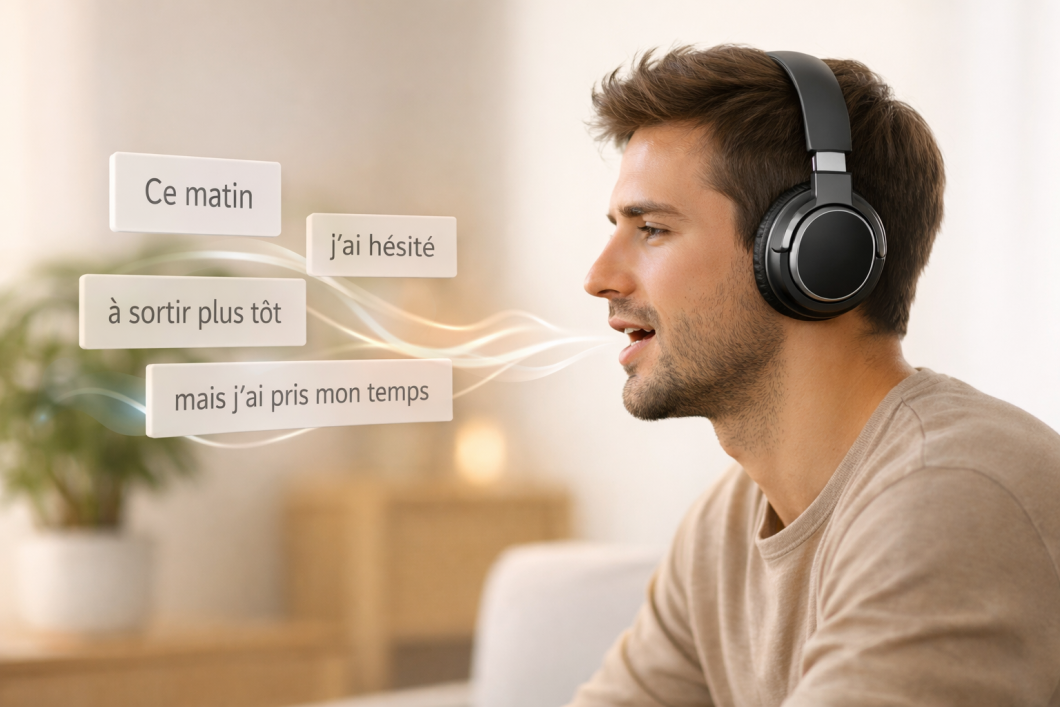
Shadowing is a technique where you speak at the same time (or almost at the same time) as a French model, focusing less on individual words and more on rhythm, melody, and flow 🗣️🎶
You’re not trying to be perfect. You’re trying to keep moving, just like real spoken French does.
This is why shadowing works so well for pronunciation: it trains your ear, your mouth, and your brain together, instead of separately.
🧠 Why Shadowing Is So Effective for French Pronunciation
French doesn’t sound the way it looks on the page — and that’s where many learners get stuck 😅
Words connect, sounds change, and sentences flow as one long stream. Shadowing helps you feel that movement instead of analyzing it.
Shadowing builds confidence. Because you’re always speaking aloud and staying in rhythm, your mouth gets used to French sounds. Over time, speaking feels less effortful and much more automatic.
If your goal is to pronounce French like a native, this kind of training is essential.
🗣️ Shadowing Exercises Without Audio (Yes, Really!)
You don’t always need podcasts or recordings to practice shadowing 🎧 Audio is helpful, but shadowing also works with written texts, especially for beginners and lower-intermediate learners.
Here are two powerful exercise types you can use right away 👇
🟦 Exercise Type 1: Rhythmic Shadowing with Slashes
These slashes show how French is spoken in groups, not word by word.
Exercise 1
👉 Read aloud, following the slashes. Keep your voice moving.
Ce matin / j’ai hésité / à sortir plus tôt /
mais finalement / j’ai pris mon temps.
Exercise 2
👉 Read as if you’re explaining something casually to a friend.
Alors / en fait / le problème /
c’est que / personne ne m’avait prévenu.
This is great for sounding more natural and less “textbook” 😊
Exercise 3
👉 Read twice. The second time, go a bit faster 🚶♂️➡️🏃♂️
Franchement / je pensais que ce serait plus compliqué /
mais au final / tout s’est bien passé.
🟦 Exercise Type 2: Shadowing with Immediate Transformation
This is where things get really powerful 💪
You repeat a sentence and immediately change one element, without stopping.
Exercise 4: Change the Time ⏰
Je travaille aujourd’hui.
→ Je travaille demain.
→ Je travaillais hier.
Exercise 5: Make It Negative 🚫
Elle comprend le problème.
→ Elle ne comprend pas le problème.
Exercise 6: Change the Subject 👥
Je prends le train tous les jours.
→ Il prend le train tous les jours.
→ Nous prenons le train tous les jours.
These exercises train your brain to react quickly — just like in real conversations.
⏱️ How Often Should You Practice Shadowing?
You don’t need hours a day 🙌 What really works is short, daily practice.
Aim for:
-
⏰ 10–15 minutes
-
🗣️ speaking out loud
-
🔁 repeating the same material for a few days
That’s one of the best ways to learn French efficiently without burning out.
🎯 Make Your French Sound Alive
French pronunciation isn’t about sounding perfect. It’s about sounding natural, confident, and fluid 🌊
Shadowing helps you stop thinking about every single French word and start focusing on how French actually sounds when people speak.
So don’t wait until you’re “ready.”
Don’t wait until you’re advanced.
Start shadowing now — even with simple texts — and let your French grow naturally, one sentence at a time 🇫🇷✨
Your French doesn’t need to be perfect — it just needs to move 😉
If you found this helpful:
-
💬 Leave a comment and tell me if you want more shadowing exercises — I’ll share new ones there
-
📩 Subscribe for weekly French learning tips
-
See our article on How to improve your French accent
FAQ – Shadowing and French Pronunciation
What is shadowing in French learning?
Shadowing is a technique where learners repeat spoken French almost at the same time as a model, focusing on rhythm, intonation, and flow rather than individual words.
Can beginners use shadowing?
Yes. Beginners can start with short sentences and even written texts. Shadowing helps build good pronunciation habits early.
Do I need audio to practice shadowing?
No. While audio is useful, shadowing can be practiced effectively with written texts using rhythm markers such as slashes.
How long should I practice shadowing each day?
Ten to fifteen minutes per day is enough if practice is consistent and done aloud.