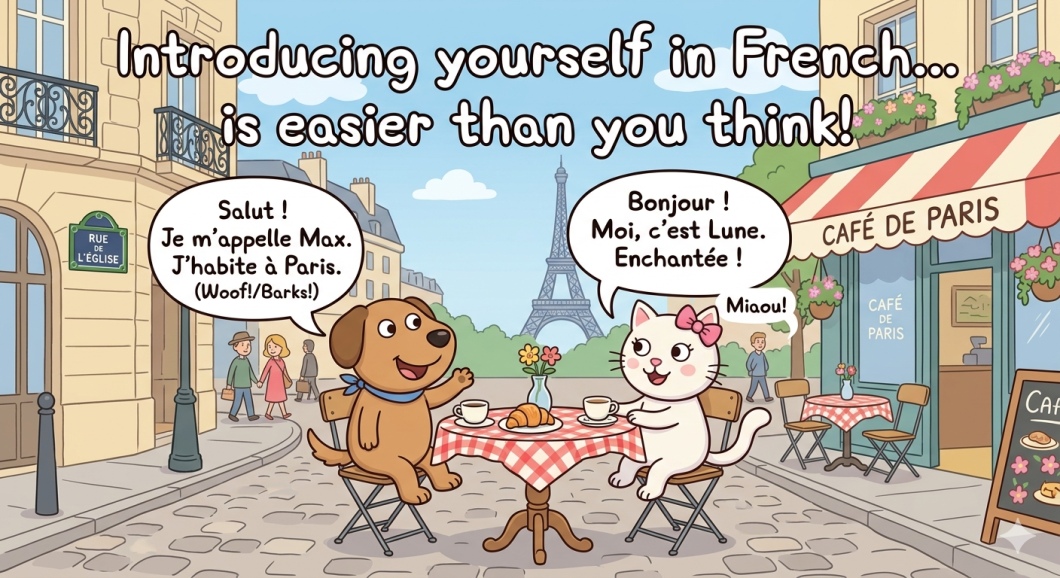
🇫🇷👋 Meeting someone for the first time in French can feel stressful.
You may know grammar rules, but when it’s time to actually speak, your mind suddenly goes blank.
Should you say Bonjour or Salut?
Is Je m’appelle always natural?
Do French people really introduce themselves the way textbooks teach?
The good news is: French introductions are actually quite simple once you learn the most useful phrases and understand how native speakers really talk.
🐸 In this guide, you’ll learn:
- how to introduce yourself in French naturally,
- useful beginner French introduction phrases,
- formal vs informal French introductions,
- pronunciation tips,
- and real spoken French examples you can start using immediately.
☕How to Introduce Yourself in French?
Here’s a simple beginner-friendly self introduction in French:
Bonjour ! Je m’appelle Anna.
Je suis américaine.
J’habite à Chicago.
Je viens des États-Unis.
Enchantée !
English translation:
Hello! My name is Anna.
I’m American.
I live in Chicago.
I come from the United States.
Nice to meet you!
This basic structure works in most everyday situations and is one of the easiest ways to introduce yourself in French for beginners.
🥐Basic French Greetings for Introductions
Before introducing yourself, you usually start with a greeting.
Bonjour
Bonjour means hello or good morning.
It is the safest and most common greeting in French.
Pronunciation:
bon-zhoor
The “r” at the end is soft and comes from the throat.
Use Bonjour:
- at work,
- in shops,
- at school,
- with strangers,
- in formal situations.
Example:
Bonjour, je m’appelle David.
Salut
Salut means hi.
It is informal and friendly.
Use it:
- with friends,
- classmates,
- people your age,
- casual situations.
Example:
Salut ! Moi, c’est Emma.
Bonsoir
Bonsoir means good evening.
French speakers often switch from Bonjour to Bonsoir later in the day.
Example:
Bonsoir, je m’appelle Nicolas.
🥐🥐How to Say Your Name in French
There are several ways to say your name in French.
Some are more natural than others.
Je m’appelle…
This is the classic beginner French introduction phrase.
Meaning:
My name is…
Example:
Je m’appelle Sophie.
Pronunciation tip:
French speakers often pronounce it quickly:
zhuh mah-pel
The “je” becomes very soft in natural speech.
This phrase is always correct and works in both formal and informal situations.
Moi, c’est…
This is extremely common in spoken French.
Meaning:
I’m… / Me, I’m…
Example:
Moi, c’est Lucas.
Native speakers use this structure all the time in conversations because it sounds relaxed and natural.
If you want to introduce yourself in French naturally, this phrase is very useful.
Mon prénom est…
Meaning:
My first name is…
Example:
Mon prénom est Camille.
This version exists, but native speakers use it less often in everyday conversation.
It can sound slightly formal or administrative.
🥐🥐🥐Talking About Age, Nationality, and Where You Live
Once you say your name, you can add a few details about yourself.
Saying Your Age
French uses the verb avoir (to have), not to be.
Structure:
J’ai + age + ans
Example:
J’ai 24 ans.
Common beginner mistake:
❌ Je suis 24 ans
✅ J’ai 24 ans
Saying Your Nationality
Structure:
Je suis + nationality
Examples:
Je suis canadienne.
Je suis anglais.
Je suis américaine.
Remember:
Nationality adjectives change depending on gender.
| Masculine | Feminine |
|---|---|
| américain | américaine |
| anglais | anglaise |
| italien | italienne |
Saying Where You’re From
Structure:
Je viens de…
Examples:
Je viens du Canada.
Je viens des États-Unis.
Je viens de Londres.
This phrase is very common in French conversation for beginners.
Saying Where You Live
Structure:
J’habite à…
Examples:
J’habite à Paris.
J’habite à Luxembourg.
🎙️Mini Dialogue Example
— Bonjour ! Je m’appelle Alex.
— Salut ! Moi, c’est Léa.
— Tu viens d’où ?
— Je viens du Canada. Et toi ?
— Moi, je suis français.
Translation:
— Hello! My name is Alex.
— Hi! I’m Léa.
— Where are you from?
— I’m from Canada. And you?
— I’m French.
🗣️Formal vs Informal French Introductions
One important part of basic French conversation is understanding formality.
Formal Introductions
Use formal French:
- at work,
- with teachers,
- with older people,
- in professional situations.
Example:
Bonjour, je m’appelle Marie Dupont.
Enchantée de faire votre connaissance.
French culture often values politeness during first interactions.
Informal Introductions
With friends or younger people, French becomes more relaxed.
Example:
Salut ! Moi c’est Julien.
Tu vs Vous
French has two ways to say “you”.
| French | Use |
|---|---|
| tu | informal |
| vous | formal or plural |
Examples:
Tu t’appelles comment ?
Comment vous appelez-vous ?
For beginners, vous is usually the safer option with strangers.
💬How Native French Speakers Introduce Themselves Naturally
This is where French textbooks and real spoken French can feel very different.
Native speakers often shorten words, simplify pronunciation, and use more relaxed phrasing.
“Moi, c’est…”
Textbooks:
Je m’appelle Sophie.
Natural spoken French:
Moi, c’est Sophie.
This sounds very common and conversational.
“J’suis…”
In spoken French, je suis often becomes:
J’suis
Example:
J’suis de Lyon.
You’ll hear this constantly in real life.
➡️French Rhythm Is Fast and Connected
French speakers link words together smoothly.
Example:
Je m’appelle Anna
Often sounds closer to:
“zhmah-pel Anna”
This is one reason spoken French feels difficult for beginners.
“Enchanté”
French people often say:
Enchanté !
Enchantée !
Meaning:
Nice to meet you!
The feminine version adds an extra “e” in writing:
- masculine: enchanté
- feminine: enchantée
But pronunciation stays almost identical.
🫣Common Beginner Mistakes
Here are some very common mistakes English speakers make during self introduction in French.
1. Saying “Je suis 20 ans”
French says:
J’ai 20 ans.
Not:
Je suis 20 ans.
2. Pronouncing Silent Letters
French contains many silent letters, especially at the ends of words.
For example:
Tu parles
Beginners often pronounce the final “s”:
❌ tu parless
But in natural French, the “s” is silent:
✅ tu parle
This happens very often in French:
- ils parlent → final “ent” is silent
- petit → final “t” is usually silent
- français → final “s” is silent
Learning which letters are silent is one of the keys to understanding spoken French more easily.
3. Using Only Formal French
Some learners sound overly formal all the time.
Example:
Comment vous appelez-vous ?
Correct — but very formal in casual conversation.
Native speakers often say:
Tu t’appelles comment ?
4. Forgetting Gender in Nationalities
Incorrect:
Je suis américain. (spoken by a woman)
Correct:
Je suis américaine.
5. Translating Directly From English
English:
I am from Canada.
French:
Je viens du Canada.
Not:
Je suis de Canada.
🪄 Complete Self-Introduction Examples
Formal Self Introduction in French
Bonjour, je m’appelle Claire Martin.
Je suis française et j’habite à Lyon.
Je travaille dans le marketing.
Enchantée de faire votre connaissance.
Translation:
Hello, my name is Claire Martin.
I’m French and I live in Lyon.
I work in marketing.
Nice to meet you.
Casual Spoken Introduction
Salut ! Moi c’est Max.
J’suis belge et j’habite à Bruxelles.
Translation:
Hi! I’m Max.
I’m Belgian and I live in Brussels.
Beginner-Friendly Dialogue
— Bonjour ! Tu t’appelles comment ?
— Je m’appelle Sarah. Et toi ?
— Moi, c’est Tom. Tu viens d’où ?
— Je viens d’Angleterre.
Translation:
— Hello! What’s your name?
— My name is Sarah. And you?
— I’m Tom. Where are you from?
— I’m from England.
🎭Mini Practice
Complete the sentences:
- Bonjour, je ______ Emma.
- Je ______ du Canada.
- J’______ à Paris.
- Moi, c’______ Lucas.
- J’______ 18 ans.
Answers:
- m’appelle
- viens
- habite
- est
- ai
Final Thoughts
Learning how to introduce yourself in French is one of the first big milestones for beginners.
At first, French introductions may feel intimidating — especially when native speakers talk quickly. But most real conversations actually use a small number of simple phrases repeated again and again.
Start with:
- Bonjour
- Je m’appelle…
- Je viens de…
- J’habite à…
Then gradually add more natural spoken French expressions like:
- Moi, c’est…
- J’suis…
- Enchanté !
The more you hear and repeat these phrases, the more natural they’ll become. And very soon, introducing yourself in French will feel automatic rather than stressful.
Want to Improve Your French Faster?
📩 Subscribe to the newsletter for:
- practical French learning tips,
- pronunciation insights,
- beginner-friendly explanations,
- and real spoken French examples delivered regularly.