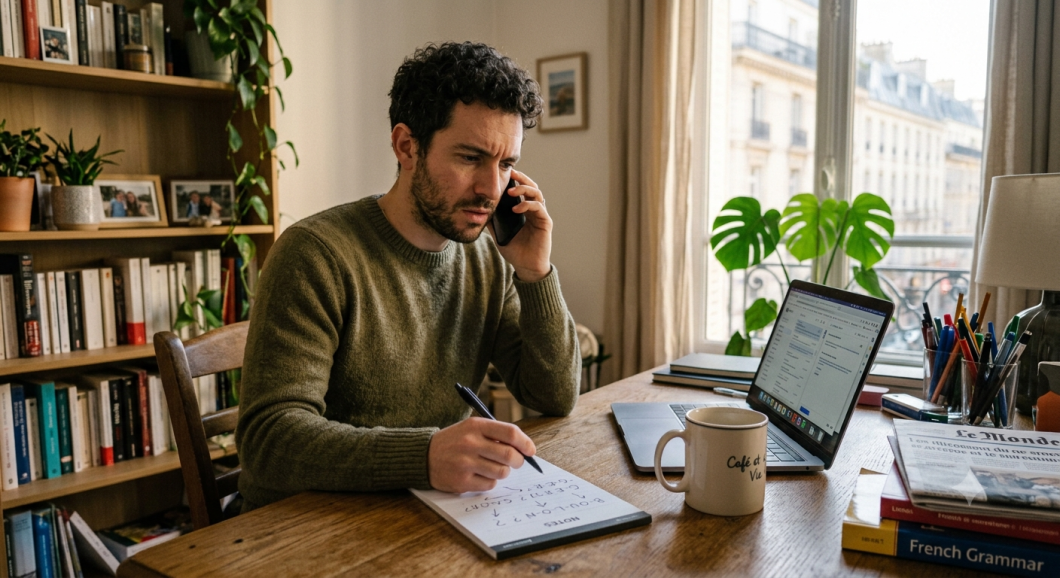
You order a coffee.
The waiter smiles and replies.
You recognise one or two words…
…but the rest sounds impossibly fast.
If you’ve recently moved to France, Luxembourg, Belgium or another French-speaking country, you’ve probably experienced this more than once.
Many expats tell me the same thing:
“I can read French quite well, but when people speak, I understand almost nothing.”
As a certified French teacher, I see this challenge every week with English-speaking professionals and expatriates.
The reason is simpler than most people think.
French and English share the same alphabet—but they follow very different pronunciation rules.
Once you understand those patterns, spoken French becomes much easier to follow.
If this situation sounds familiar, this is exactly the type of pronunciation work I help students improve during my one-to-one online French lessons.
Why Is Spoken French So Hard to Understand?
If you’re an English-speaking expat, you may wonder why reading French feels manageable while understanding spoken French seems almost impossible.
The good news is that this is a very common experience.
In fact, many of my students arrive at their first lesson saying exactly the same thing:
“I can read menus, emails and news, but I can’t follow a simple conversation.”
The reason isn’t that French is spoken unusually fast or that you’re bad at languages.
It’s because your brain is still trying to apply English pronunciation rules to French words.
When you read a word like restaurant, beaucoup or parlent, you naturally expect it to sound similar to English. But French follows completely different pronunciation patterns.
On top of that, French speakers often link words together, don’t pronounce many final letters, and use sounds that simply don’t exist in English.
The result? You already know more vocabulary than you think—you just don’t recognise it when you hear it.
The encouraging news is that this becomes much easier once you understand the most common pronunciation patterns. Instead of trying to memorise thousands of new words, you learn to hear familiar words the way native speakers actually pronounce them.
That’s exactly what we’ll explore in the rest of this guide.
The French and English Alphabets Look the Same — So Why Do They Sound So Different?
One of the biggest surprises for beginners is that French and English share the same 26 letters.
At first glance, that seems reassuring. If you already know the alphabet, learning French pronunciation should be easy, right?
Not exactly.
The challenge isn’t the letters themselves. It’s the pronunciation rules attached to those letters.
For example:
- English: cake → the A sounds like “ay”
- French: gare → the A sounds like “ah”
Similarly:
- English: music
- French: musique
Even though both words look related, the sounds are quite different.
Many pronunciation difficulties happen because English speakers instinctively apply English reading rules to French words. Unfortunately, French has its own sound system.
Once you stop trying to pronounce French like English, things become much easier.
French Vowels Are Not English Vowels
Vowels are often where pronunciation problems begin.
A
French A is usually stable and clear:
- facture
- travail
- table
Think of the “a” in “father.”
E
French E has several pronunciations depending on accents and position in the word.
Examples:
- le
- demain
- parler
This is one reason why French pronunciation for beginners can feel challenging.
I
French I is generally straightforward:
- ici
- vivre
- difficile
It sounds similar to the “ee” in “see.”
O
French O tends to be more rounded than English:
- mot
- portable
- téléphone
U: The Sound That Frustrates Beginners
The French U is often considered the hardest French sound for English speakers.
Examples:
- tu
- lune
- bureau
This sound does not really exist in standard English.
A useful trick is to say “ee” while rounding your lips as if saying “oo.”
The French u sound frustrates almost every English-speaking beginner I teach.
Many students tell me, “I can hear the difference when you say it, but I can’t make the sound myself.”
The good news is that this isn’t a talent issue. With the right mouth position and a little practice, most learners can produce a much clearer French u within a few lessons.
French Accents Change Pronunciation
One major difference between French and English is the use of accents.
Understanding French accents explained simply can save you from many pronunciation mistakes.
É (accent aigu)
Produces a clear “ay” sound.
Examples:
- supermarché
- été
- médecin
È (accent grave)
Produces a more open sound.
Examples:
- père
- très
- après
Ê (accent circonflexe)
Usually sounds similar to È.
Examples:
- fête
- forêt
- tête
Ë (tréma)
Indicates that vowels should be pronounced separately.
Example:
- Noël
Many beginners ignore accents because English doesn’t use them. In French, however, accents are part of the spelling and often affect pronunciation directly.
The Shock of Silent Letters
This is where many learners experience their first real culture shock.
French contains a large number of silent letters.
English speakers naturally want to pronounce every letter they see. French speakers often don’t.
Consider these examples:
- petit → “puh-tee”
- français → final S is silent
- parlent → final ENT is silent
- beaucoup → final P is silent
- vous parlez → final Z is silent
One of my students recently laughed when she realised she had been pronouncing every final consonant in words like petit and beaucoup. Once she stopped expecting every written letter to be pronounced, she found it much easier to understand everyday conversations in cafés and shops.
French Consonants That Surprise English Speakers
R
The French R is famous.
Instead of being pronounced near the front of the mouth like English R, it is produced further back in the throat.
Examples:
- rouge
- bonjour
- Paris
Don’t obsess over perfection. A slightly imperfect French R will rarely prevent communication.
J
French J sounds like the sound in “measure.”
Examples:
- jour
- jaune
- janvier
It never sounds like the English J in “jump.”
G
French G can change depending on the following vowel.
Examples:
- gare
- gomme
- géographie
H
Here’s an easy one.
French H is generally silent.
Examples:
- hôtel
- heure
- habiter
Many English speakers accidentally pronounce the H when they shouldn’t.
If you live in a French-speaking country and often find yourself asking people to repeat what they said, pronunciation—not vocabulary—is often the missing piece.
This is exactly what we practise during my online French lessons.
Why French People May Not Understand Your Spelling
Imagine you’re making a restaurant reservation over the phone.
You say:
“That’s P.”
The French person replies:
“P or B?”
Suddenly you realize letter names sound different in French.
French people often clarify letters using words:
- M comme Marie
- P comme Paris
- B comme Bordeaux
- T comme Toulouse
This becomes especially useful when spelling:
- names
- email addresses
- hotel reservations
- addresses
- phone support requests
Learning the French alphabet pronunciation helps enormously in these real-life situations.
🔴The Most Common Pronunciation Mistakes English Speakers Make
After teaching hundreds of learners, I’ve noticed the same mistakes appear again and again.
1. Reading French with English pronunciation rules
Example:
- restaurant
- important
- étudiant
French follows different sound patterns.
2. Pronouncing silent letters
Examples:
- petit
- parlent
- beaucoup
Remember: many final letters disappear in speech.
3. Ignoring accents
Examples:
- café
- été
- père
Accents matter.
4. Mispronouncing U
Examples:
- tu
- lune
- musique
This is completely normal for beginners.
5. Pronouncing H
Examples:
- hôtel
- heure
- habiter
The H is usually silent.
If you’re making these mistakes, don’t panic. They are predictable stages of learning French pronunciation.
🔥Why This Matters When You Live in a French-Speaking Country
Learning these pronunciation patterns doesn’t just help you speak more clearly—it also helps you understand the French you hear every day:
- order food without asking people to repeat themselves
- understand receptionists and shop assistants
- follow conversations at work
- make doctor’s appointments more confidently
- understand your child’s teacher at school
- feel more at ease speaking with neighbours
🎯Mini Practice: Test Your French Pronunciation Skills
Look at these French words:
nez – fenêtre – bureau – gentil – froid
Without using a dictionary or audio recording, try to answer these questions:
1. Which word contains a silent letter at the end?
2. One of these words contains an accented letter. Is it pronounced like “ay” (é) or like a more open sound (è/ê)?
3. Which word contains the famous French U sound that many English speakers find difficult?
4. Which word begins with a consonant that is pronounced differently from English and sounds a bit like the “s” in measure?
5. Which word contains letters that are not pronounced exactly as an English speaker might expect?
Answers
- nez → the final z is silent.
- fenêtre → the ê is pronounced as a more open sound, not like “ay.”
- bureau → contains the French u sound.
- gentil → the g sounds like the “s” in measure.
- froid → several letters combine to create a sound that is quite different from typical English pronunciation.
If you found some of these difficult, that’s completely normal. Native French pronunciation follows patterns that are very different from English, and recognizing those patterns takes practice. The good news is that once you start noticing them, French pronunciation becomes much more predictable.
You May Also Be Interested In
If you’re starting your French journey, these resources can help you move from individual letters to real conversations:
- Once pronunciation becomes clearer, these 20 French Words to Start Speaking are a great next step.
- Discover best Free French Learning Apps
- If speaking still feels intimidating, you may also enjoy my guide on How to Overcome the Fear of Speaking French
🎁 Free French Pronunciation Starter Guide for English-Speaking Expats
If you’re living in a French-speaking country, understanding pronunciation can make everyday life much less stressful.
That’s why I’ve created a free French Pronunciation Cheat Sheet for Expats.
Inside you’ll discover:
✅ The 10 pronunciation rules every beginner should know
✅ The most common silent letters you’ll hear every day
✅ How to pronounce tricky French sounds like u, r, eu and ou
✅ The accents that actually change pronunciation (and the ones that don’t)
✅ Everyday words from cafés, supermarkets, pharmacies and public transport to practise with
✅ Simple exercises to train your ear and improve your listening skills
Whether you’re ordering lunch, speaking with colleagues or making a doctor’s appointment, these pronunciation patterns will help you understand spoken French with more confidence.
👉 Simply fill in the short form here, and I’ll send your free French Pronunciation Starter Guide straight to your inbox.
Mini FAQ
Is the French alphabet different from English?
No. French and English both use the same 26 letters. The main difference lies in pronunciation and spelling rules.
Why is French pronunciation difficult?
French pronunciation feels difficult because many letters are pronounced differently from English, and many written letters are silent.
What is the hardest French sound for English speakers?
The French U sound is often the most difficult because it does not exist in standard English.
Do French people pronounce every letter?
No. Many French words contain silent letters, especially at the ends of words.
Why do French words look different from how they sound?
French spelling preserves historical forms, while modern pronunciation has evolved over time, creating a gap between spelling and speech.
Final thoughts
Moving to a French-speaking country can feel overwhelming when you understand written French but struggle to follow conversations.
The encouraging news is that this usually isn’t a vocabulary problem.
It’s a pronunciation problem.
Once you learn the most common pronunciation patterns, French suddenly becomes much easier to recognise in real conversations.
I’ve seen this happen with many English-speaking expats who initially felt discouraged but quickly gained confidence after focusing on pronunciation rather than memorising endless vocabulary lists.
Ready to Understand Spoken French with More Confidence?
If you’ve been feeling frustrated because you can read French but struggle to understand conversations, remember that you’re not starting from scratch. You already recognise many of the words—you simply need to learn how French speakers actually pronounce them.
That’s a skill you can develop with the right guidance and regular practice.
If you’re living in France, Luxembourg, Belgium or Switzerland and want to feel more comfortable in everyday conversations, I’d be happy to help.
I’m Katia, a certified French teacher (DU FLE, Université Grenoble), and I specialise in helping English-speaking expatriates build practical French for daily life and work.
Together we’ll improve your pronunciation, listening skills and speaking confidence through personalised online lessons adapted to your goals.
👉 Book your first online French lesson and start understanding spoken French more naturally.