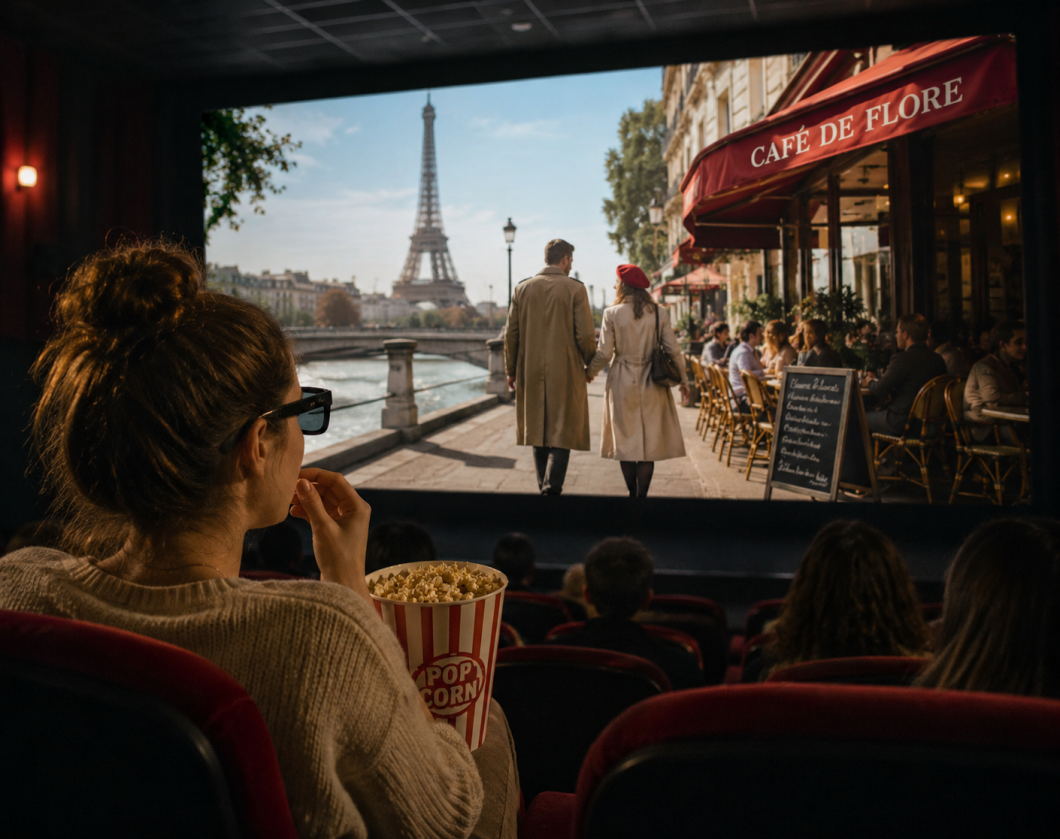
Planning a trip to France but worried you won’t understand people once you arrive? Many travellers learn useful vocabulary before they leave, then discover that native speakers talk much faster than expected. Watching French movies before your trip is one of the easiest ways to train your ear for real conversations you’ll hear in cafés, bakeries, trains, hotels, and shops.
I often see this with my students before they travel to France. They know basic French grammar but feel nervous because authentic spoken French sounds very different from textbook dialogues.
If you’re preparing for a trip to France, this is exactly the type of listening practice we work on in my personalised 1:1 online French lessons.
Which French Movies Should You Watch Before Visiting France?
As a certified French teacher, I’ve noticed that learners often believe they need to understand every word before they can enjoy French films.
In reality, the students who improve fastest focus on recognising familiar expressions rather than translating complete sentences.
Some of the best French movies for intermediate learners include:
- Les Choristes
- Intouchables
- Belle et Sébastien
- Les Vacances du Petit Nicolas
- Kirikou et la Sorcière
These films usually feature slower dialogue, emotional storytelling, family interactions, and clearer pronunciation than many fast-paced French thrillers or comedies.
🎞️ How to Learn French With Movies Effectively
Watching French movies can become extremely powerful French listening practice — but only if you watch actively.
🍿 Start with French subtitles
French subtitles help your brain connect sounds with spelling. Spoken French often sounds very different from textbook French because native speakers link words together.
🍿 Rewatch short scenes
Watching a 2-minute scene three times is often more effective than passively watching an entire movie.
Try this progression:
- Watch normally.
- Watch again with subtitles.
- Listen one more time without reading.
You will notice expressions you completely missed the first time.
🍿Focus on repeated expressions
Native speakers constantly repeat common structures:
- Ça va ?
- Qu’est-ce que tu fais ?
- T’inquiète.
Movies help these expressions become automatic.
🍿Learn vocabulary in emotional context
Vocabulary learned through emotion stays longer in memory. A touching scene or funny interaction helps words feel alive instead of abstract.
This is exactly how I help students prepare for trips to France. During my personalised lessons, we practise authentic dialogues before moving on to films, podcasts and real conversations.
If you enjoy pronunciation-focused immersion methods, you may also like this article about emproving French pronunciation with shadowing technique.
🎒 What Movies Can (and Can’t) Prepare You For
Movies won’t teach you everything you’ll hear in France, but they will help you become familiar with:
- how quickly French people link words together
- common greetings and polite expressions
- everyday family conversations
- different speaking speeds and accents
- how emotions change pronunciation
That means you’ll be much less surprised when ordering in a café or asking for directions.
1. Les Choristes (2004)
Director: Christophe Barratier
Main actors: Gérard Jugnot, François Berléand
Difficulty: A2–B1
This beloved French film follows a music teacher who arrives at a strict boarding school for troubled boys and slowly transforms their lives through singing.
The pace of speech is calm, and many conversations are emotionally clear and easy to follow. Because the film centers around children, learners hear simpler sentence structures and repeated classroom vocabulary.
Ideal for learners who struggle with fast spoken French.
Expressions you may hear:
- Écoutez-moi — “Listen to me”
- Il faut travailler — “You need to work”
- Ne fais pas ça — “Don’t do that”
Try this while watching:
- Train your ear to clear, carefully articulated French by repeating the teachers’ instructions aloud.
- Listen for common classroom expressions and imperative verbs like Écoutez, Travaillez, and Ne fais pas ça, which also help you recognise commands in everyday conversations.
2. Belle et Sébastien (2013)
Director: Nicolas Vanier
Main actors: Félix Bossuet, Tchéky Karyo
Difficulty: A2–B1
Set in the French Alps during World War II, this touching story follows a young boy and his friendship with a mountain dog named Belle.
The dialogue is slower and more natural than in many modern French films. Conversations revolve around daily life, emotions, and family relationships.
For intermediate learners, this is an excellent introduction to authentic French movies because the storytelling is visual and emotionally intuitive.
Expressions you may hear:
- On y va — “Let’s go”
- Tu comprends ? — “Do you understand?”
- Fais attention — “Be careful”
Try this while watching:
- Practise understanding conversations without relying on every word by following the characters’ emotions and body language.
- Repeat short everyday phrases such as On y va and Fais attention until they become automatic.
3. Kirikou et la Sorcière (1998)
Director: Michel Ocelot
Difficulty: A2
This animated classic tells the story of a brave little boy named Kirikou who tries to understand why the sorceress Karaba has become cruel.
Animated films are often excellent for French listening practice because characters speak more clearly and expressively than in fast live-action movies.
The narration and dialogue are generally accessible, making this one of the best French movies with clear pronunciation for lower intermediate learners.
Expressions you may hear:
- Pourquoi ? — “Why?”
- J’ai peur — “I’m scared”
- Viens ici — “Come here”
Try this while watching:
- Pause after each short dialogue and repeat the sentences aloud to improve your pronunciation and rhythm.
- Notice how questions like Pourquoi ? and simple everyday verbs are pronounced in natural speech.
4. Ernest et Célestine (2012)
Difficulty: A2–B1
This gentle animated film tells the story of an unlikely friendship between a bear and a young mouse.
The language feels natural without becoming overwhelming. Characters speak clearly, and many conversations are emotionally expressive rather than linguistically complicated.
One of the most useful aspects of this movie is its conversational rhythm. Learners hear authentic spoken French that still remains understandable.
Expressions you may hear:
- Tu viens ? — “Are you coming?”
- Je ne veux pas — “I don’t want to”
- C’est impossible — “That’s impossible”
Try this while watching:
- Listen for natural conversational rhythm and imitate the characters’ intonation rather than translating every sentence.
- Practise recognising everyday negatives such as Je ne veux pas and common invitations like Tu viens ?
5. Intouchables (2011)
Director: Olivier Nakache and Éric Toledano
Main actors: Omar Sy, François Cluzet
Difficulty: B1
This hugely popular film tells the story of an unexpected friendship between a wealthy disabled man and his caregiver.
The spoken French here is more modern and informal than in some family films, which makes it extremely valuable for learners who want exposure to contemporary spoken French.
Some dialogue moves quickly, but the emotional clarity of the scenes helps learners stay engaged.
Expressions you may hear:
- T’inquiète — “Don’t worry”
- Ça marche — “Sounds good”
- J’en peux plus — “I can’t take it anymore”
Try this while watching:
- Get used to modern spoken French by listening for contractions such as T’inquiète instead of Ne t’inquiète pas.
- Replay short conversations and identify informal expressions that French people use every day with friends.
Many travellers tell me that understanding spoken French is much harder than reading it. During my personalised 1:1 lessons, we practise exactly this skill using authentic audio, dialogues, and role plays based on real travel situations, so you’ll feel more confident when you arrive in France.
6. Les Vacances du Petit Nicolas (2014)
Director: Laurent Tirard
Difficulty: A2–B1
This charming family comedy follows Nicolas and his family during summer vacation.
The movie is full of realistic family interactions, which makes it especially useful for spoken French learners.
You will hear practical everyday conversations, playful reactions, and lots of natural family French.
Expressions you may hear:
- C’est génial ! — “That’s great!”
- Qu’est-ce qu’on fait ? — “What are we doing?”
Try this while watching:
- Build useful holiday vocabulary by listening to conversations about family activities, meals, and outdoor games.
- Shadow short dialogues between parents and children to improve your speaking fluency.
7. Le Petit Spirou (2017)
Director: Nicolas Bary
Difficulty: A2–B1
This light-hearted comedy centers around a young boy trying to enjoy childhood before supposedly following a family tradition of becoming a hotel bellboy.
The movie contains lots of school conversations and child-to-child interactions, which are often easier for intermediate learners to understand than adult professional dialogue.
Expressions you may hear:
- C’est pas juste — “That’s not fair”
- Laisse-moi tranquille — “Leave me alone”
- Tu plaisantes ? — “Are you joking?”
Try this while watching:
- Practise recognising everyday reactions such as C’est pas juste ! and Tu plaisantes ? without translating them word for word.
- Repeat the children’s conversations to become more comfortable with natural spoken speed.
8. Le Petit Nicolas (2009)
Director: Laurent Tirard
Difficulty: A2–B1
This film captures everyday childhood experiences through simple but authentic conversations.
Many learners find this movie surprisingly useful because the narration helps structure the story clearly.
You hear classroom French, emotional reactions, and repeated expressions used naturally by children and parents.
Expressions you may hear:
- J’ai une idée — “I have an idea”
- Qu’est-ce qu’il y a ? — “What’s wrong?”
- C’est ma faute — “It’s my fault”
Try this while watching:
- Listen for high-frequency expressions you’ll hear in everyday life, such as Qu’est-ce qu’il y a ? and J’ai une idée.
- Pause after short scenes and summarise what happened in one or two simple French sentences.
9. La Guerre des Boutons (2011)
Director: Yann Samuell
Difficulty: B1
This adventure film about rival groups of children combines humor, emotion, and accessible dialogue.
The rural setting introduces some regional accents, but the language remains understandable overall.
This is a good bridge toward more authentic spoken French because conversations feel spontaneous without becoming too fast.
Expressions you may hear:
- On a gagné ! — “We won!”
- Tu viens avec nous ? — “Are you coming with us?”
- C’est une catastrophe — “It’s a disaster”
Try this while watching:
- Train your ear to understand spontaneous group conversations where several people speak one after another.
- Listen for expressions of surprise, excitement, and disagreement that are common in everyday spoken French.
10. Le Prénom (2012)
Director: Alexandre de La Patellière and Matthieu Delaporte
Main actors: Patrick Bruel, Valérie Benguigui, Charles Berling
Difficulty: B1
Unlike the family-oriented movies above, Le Prénom is an excellent next step for learners who want exposure to faster adult conversations.
The film revolves around a dinner party that slowly turns into a hilarious and emotional argument after one guest reveals the future name of his baby.
The dialogue feels incredibly authentic. Characters interrupt each other, tease each other, react emotionally, and use natural conversational French exactly as native speakers do in real life.
For learners, this movie is particularly useful because almost the entire film is based on conversation.
Expressions you may hear:
- Tu te moques de moi ? — “Are you kidding me?”
- Ça suffit — “That’s enough”
- J’ai rien dit — “I didn’t say anything”
Try this while watching:
- Practise following fast conversations without trying to understand every word—focus instead on the speakers’ emotions and repeated expressions.
- Replay one dinner-table scene and identify conversation fillers like ben, alors, and bon, which native speakers use constantly.
If you enjoy learning modern everyday expressions through authentic spoken French, you may also like my post about 20 modern French expressions you need to know.
Why Movies Are So Effective for Spoken French
Textbook dialogues are useful at the beginning, but authentic French movies expose learners to something much more important: real rhythm.
You begin noticing:
- how French speakers shorten words,
- where they pause,
- how emotions change pronunciation,
- and how common expressions repeat constantly.
This kind of exposure gradually trains your ear in a way grammar exercises alone cannot.
And perhaps most importantly, movies create emotional motivation. Learners naturally stay consistent longer when they genuinely enjoy what they are watching.
If you want to combine movie immersion with structured study, you can also explore different ways to learn French online through conversation practice, guided listening, and interactive lessons.
FAQ: Learning French With Movies
Should I use English subtitles or French subtitles?
French subtitles are usually more effective for intermediate learners because they connect pronunciation and spelling.
How many words should I understand in a French movie?
Around 60–80% is already excellent for learning. You do not need complete comprehension to improve your listening skills.
Can watching French movies really improve listening?
Yes. Movies expose you to natural pronunciation, contractions, emotions and conversational rhythm that textbooks rarely teach.
Which French movie should I watch before travelling to France?
If you’re an A2 learner, start with Les Choristes or Belle et Sébastien. They use clear pronunciation and everyday vocabulary that’s useful when travelling.
Should beginners watch French movies without subtitles?
Not at first. Start with French subtitles so your brain connects spoken and written French, then gradually watch short scenes without subtitles.
How often should I watch French movies?
Even one film a week can significantly improve listening if you actively pause, repeat scenes and note useful expressions.
Are French TV series better than movies?
Both help. Movies are ideal for concentrated listening practice, while TV series expose you to recurring vocabulary and familiar voices over multiple episodes.
What You Should Listen for While Watching
Instead of trying to understand everything, focus on noticing:
✔ greetings
✔ ordering food
✔ asking for directions
✔ thanking people
✔ apologising
✔ everyday fillers like:
- ben…
- alors…
- bah…
- voilà
If you’re also preparing useful vocabulary for your holiday, you may enjoy my guide on Essential French Vocabulary for Travellers.
Final Thoughts
One surprisingly effective way to improve spoken French is to combine different kinds of immersion instead of relying on only one method.
Movies train your ear for emotion and natural rhythm. But learners often progress even faster when they also listen to easy French news podcasts, read graded readers, follow French YouTube creators, or listen repeatedly to short audio clips during everyday activities like cooking, walking, or commuting.
The goal is not perfect understanding. The goal is building familiarity with the music of spoken French until common expressions begin to feel natural.
If you’re travelling to France and want to understand native speakers with more confidence, I’d be happy to help.
During my personalised 1:1 online lessons, we’ll work with authentic audio, practical travel dialogues, and real spoken French so you can feel comfortable ordering food, asking for directions, chatting with locals, and enjoying your trip—not just memorising grammar rules.
👉 Book your first lesson here.