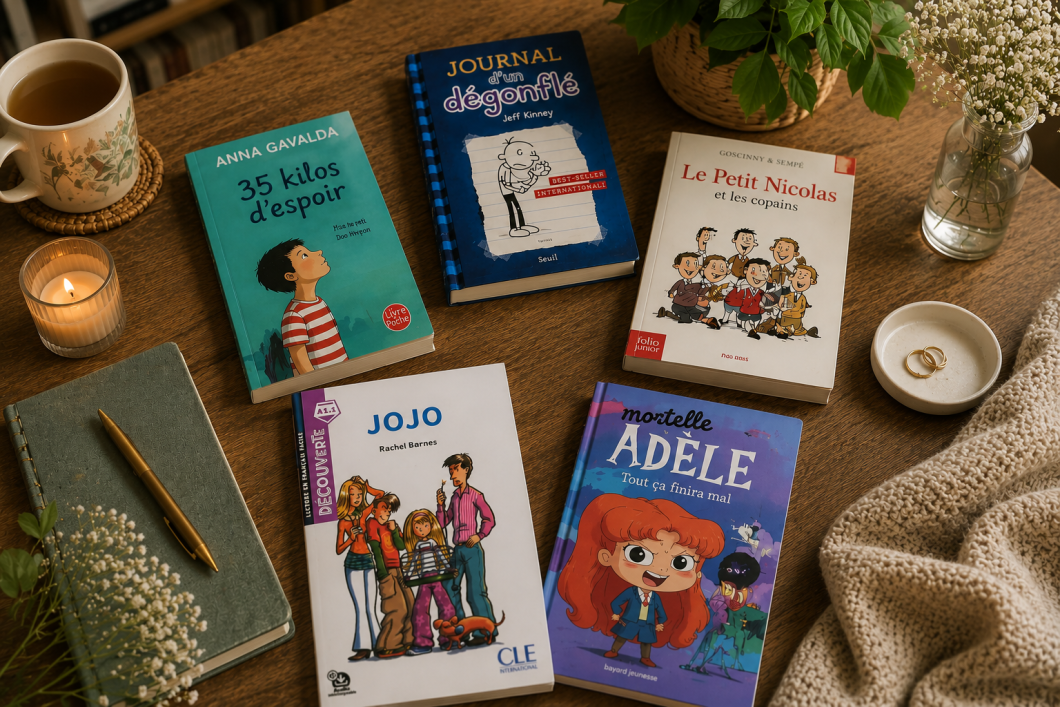
Looking for French books your child will actually enjoy reading?
Many parents tell me the same thing:
“My child doesn’t mind learning French… but refuses to read French books.”
Sometimes the books are simply too difficult. Sometimes they’re full of vocabulary a beginner has never seen before. And sometimes they’re so obviously “educational” that children lose interest after just a few pages.
As a certified French teacher, I see this regularly with the families I work with. In many cases, choosing a book that is just slightly easier—not harder—completely changes a child’s confidence.
In this guide, you’ll discover French books that A1–B1 learners can actually finish and enjoy.
If your child enjoys learning French but struggles to build confidence through reading, this is exactly the kind of challenge I help families overcome in my personalised one-to-one French lessons.
The Best French Books for A1–B1 Learners
1. Jojo
Rachel Barnes
Best for hesitant readers beginning French, children, adults restarting French, and learners who need reassurance.
The story follows Aude, a teenager who receives a rabbit named Jojo for her birthday. One day, she enters her bedroom and discovers the cage is empty. The book combines simple everyday language with a tender family story that feels reassuring and easy to follow for learners.
Difficulty: A1–A2
Why it works pedagogically:
The vocabulary repeats naturally, grammar stays accessible, and learners experience early success very quickly.
Emotionally, Jojo feels safe. Readers rarely feel overwhelmed, which is extremely important during the early stages of learning French.
I’ve recommended Jojo to several beginner learners who were nervous about reading their first French book. Because the language is so accessible, many finish it feeling far more confident than they expected.
2. Le Petit Nicolas et les Copains
René Goscinny (texte), Jean-Jacques Sempé (illustrations)
Best for curious readers, bilingual children, strong A2 learners, and adults wanting authentic French with humor.
Le Petit Nicolas et les Copains follows Nicolas and his group of school friends through funny misunderstandings, playground adventures, and chaotic everyday situations told from a child’s perspective.
Other books from the Petit Nicolas series are also excellent for learners once they feel comfortable with this level.
Difficulty: A2–B1
Why it works pedagogically
The chapters are short, dialogue-heavy, and culturally rich without becoming too literary.
Learners begin discovering authentic spoken French while staying within a manageable level.
What I notice with my students
Strong A2 learners often feel especially proud when they realise they’re reading a genuine French classic rather than a simplified textbook. That sense of achievement often motivates them to keep reading.
3. Mortelle Adèle
Mr Tan (scénario), Miss Prickly / Diane Le Feyer (dessins)
Best for reluctant readers, visual learners, tweens, and learners who dislike traditional study methods.
Mortelle Adèle follows an imaginative and rebellious little girl who constantly creates dramatic situations, strange experiments, and darkly funny problems for everyone around her.
Difficulty: A2–B1
Why it works pedagogically:
Images support comprehension constantly, and the dialogue exposes learners to natural everyday French.
The visual context helps learners infer meaning naturally without translating everything.
Emotionally, this series reduces fear. Even hesitant readers often keep turning pages because it feels fun rather than educational.
4. 35 kilos d’espoir
Best for sensitive readers, teens, adults learning French, and learners transitioning toward authentic novels.
35 kilos d’espoir tells the story of Grégoire, a boy who struggles at school but discovers confidence through creativity, manual work, and the support of his grandfather.
Difficulty: B1
Why it works pedagogically:
The language stays relatively direct and modern. Learners encounter authentic narration without extremely dense literary prose.
This book often creates a powerful emotional connection for learners because the themes feel universal.
Many readers experience an important psychological shift here: they stop feeling like “students” and begin feeling like actual readers in French.
In my online French lessons, I often recommend books like this once learners are ready to move beyond beginner readers. It’s a great stepping stone towards authentic French literature without feeling overwhelming.
5. Journal d’un dégonflé
Best for reluctant readers, preteens, bilingual kids, and learners needing realistic French reading practice.
Journal d’un dégonflé follows Greg as he tries to survive school, friendships, embarrassing situations, and family life while documenting everything in his diary with humor and sarcasm.
Difficulty: A2–B1
Why it works pedagogically
The short chapters, illustrations, and everyday situations make it easier for learners to understand the story without stopping to translate every sentence.
What I notice with my students
Many of the children I teach who are reluctant readers become much more willing to read in French when they discover books like Journal d’un dégonflé. The familiar humour, illustrations, and short chapters make reading feel enjoyable rather than like homework.
How Do You Know If a Book Is the Right Level?
One of the biggest mistakes I see parents make is choosing books that are too difficult because they worry easier books won’t be “good enough.”
Here are three signs you’ve found the right level:
✅ Your child understands around 70–80% without a dictionary.
✅ They keep reading instead of giving up.
✅ They can explain what happened in the story afterwards—even if they don’t know every word.
If you’re unsure which level is right for your child, that’s one of the questions I help parents answer during our first lesson. A book that is slightly too easy is almost always a better choice than one that feels frustrating.
💡 Teacher’s Tip
If your child can understand about 70–80% of a page without help and wants to keep reading, you’ve probably found the right book. Motivation is a much better predictor of long-term progress than choosing the “most advanced” book.
How to Read in French Without Getting Discouraged
Parents often ask me whether children should stop and translate every unfamiliar word. While that sounds logical, it usually interrupts the flow of reading and makes the experience far less enjoyable.
Should You Translate Every Word?
No. Constant translation usually slows reading down and increases frustration.
Instead:
- read for general meaning first,
- guess words from context,
- reread short passages,
- and only look up truly important vocabulary.
In my experience, learners make much faster progress when they focus on understanding the overall story instead of trying to learn every new word immediately. Building confidence first usually leads to stronger vocabulary growth over time. Parents sometimes worry when children “skip” difficult words. In reality, experienced bilingual readers do this constantly in every language. Progress in French reading comprehension often feels invisible… until suddenly a learner realizes they finished an entire chapter without panic.
During my lessons, we often use short stories exactly like these to build reading confidence before moving on to longer texts. Once children discover they can understand French, their motivation usually increases dramatically. Rather than asking children to read books that are too difficult, I carefully choose texts that allow them to experience success from the very beginning.
🎁 Free PDF
15 French Books Every Beginner Child Can Actually Finish
Includes
- recommended age
- CEFR level
- audiobook availability
- vocabulary difficulty
- reading tips for parents
I’d be happy to send you a free copy. Simply fill in my contact form and mention “15 French Books” in your message.
Continue Helping Your Child Learn French
If you’re creating a French-speaking environment at home, these guides may also help:
- French for Kids: What Works Best at Each Age (0–3, 4–6, 7–10)
- How Early Can Kids Start Learning French? Earlier Than You Think!
- How Parents Can Help a Child Adapt to French School
FAQ: French Books for Learners
– What is the easiest type of French book for beginners?
Graphic novels, illustrated chapter books, and graded readers are usually the easiest starting point because images support comprehension.
– Are comic books good for learning French?
Yes. Comics expose learners to natural dialogue, everyday expressions, and reading flow without overwhelming blocks of text.
– Should children read books above their exact French level?
Usually, no. Books that are too difficult often create frustration and demotivation very quickly. In language learning, it is actually better to read a book that feels slightly too easy than one that feels overwhelming.
Even easy French books help learners activate passive vocabulary, recognize sentence patterns automatically, and build reading confidence. That foundation matters enormously before moving toward harder novels.
Final Thoughts
Helping a child become confident in French isn’t about finding the “perfect” book.
Over the years, I’ve worked with children from many different educational backgrounds. One thing they all have in common is that reading becomes enjoyable once the book matches their current level—not the level adults think they “should” be reading.
It’s about finding the right book for their current level—one that feels achievable, enjoyable and keeps them turning the pages.
Over the years, I’ve seen children who were convinced that reading in French was simply “not for them” become enthusiastic readers simply because they started with stories that matched their level.
If you’re not sure which books would suit your child’s French level, or you’d like personalised guidance and structured lessons, I’d be happy to help.
Whether your child is learning French at school, growing up in a bilingual family or preparing to move to a French-speaking environment, my one-to-one online lessons are designed to build confidence step by step.
👉 You can learn more about my French lessons here.
And before you go…
🎁 Download my free guide:
The first 100 French sentences every child should know
It gives children practical everyday French they can immediately recognise in books and conversations.